
Cargo Bike Regulation: EPAC Rules, London's Congestion Charge and What Design Can Do
On the eve of the much anticipated (or dreaded) UK budget, two other announcements have been sitting next to each other in my head.
In Europe, ZIV’s proposals for a new EPAC framework would hard-cap assistance ratios, peak power and vehicle weight for carrier cycles – nudging anything more capable towards L-category type approval.
In London, TfL has confirmed that from January 2026 the Congestion Charge will rise to £18 a day and electric vehicles – including vans and quadricycles – will lose their 100% exemption, replaced by partial discounts via Auto Pay.
On their own, each move can be framed as reasonable: keeping e-bikes “bicycle-like”, updating pricing for a busy city centre.
Seen together – and from the viewpoint of someone who designs and engineers cargo and light-electric vehicles – they tell a different story: the legislative conversation is drifting away from how city logistics actually works, and that drift could be quietly making it easier to stick with ICE vans than to move beyond them.
I’m not looking for regulation to do the heavy lifting on cargo bike uptake. But it helps if it isn’t leaning the wrong way…
The ZIV proposals vs the CCAN declaration
The Carrier Cycle Advocacy Network’s new Cycle Logistics Declaration paints a fairly grounded picture: carrier cycles are already taking van-kilometres off the road, handling dense urban delivery and doing it with far less noise, space and emissions than light commercial vehicles. Their usefulness depends heavily on staying within the EPAC family – with access to cycle infrastructure and relatively simple admin.
ZIV’s proposal pulls in a different direction by:
Capping the assistance ratio, which many riders – especially older, less fit or disabled riders – rely on for safe low-speed starts under load.
Capping peak power at the wheel, even though that’s precisely what keeps a fully loaded bike stable on ramps and short inclines.
Capping system weight in ways that eat into payload just as fleets are trying to consolidate more drops per trip.
Pushing anything above those thresholds into L-category, with extra type-approval, insurance, licensing and route restrictions.
I’m very much in favour of standards. EN 15194 and the emerging EN 17860 series are exactly the kind of outcome-based, testable frameworks the sector needs: they focus on braking, structural integrity, stability and electrical safety rather than a couple of headline numbers.
Where it starts to feel off is when extra power/weight caps sit on top of that work. It’s not obvious they buy much additional safety, but they do add friction and uncertainty to vehicles whose main job is to be a viable alternative to vans.
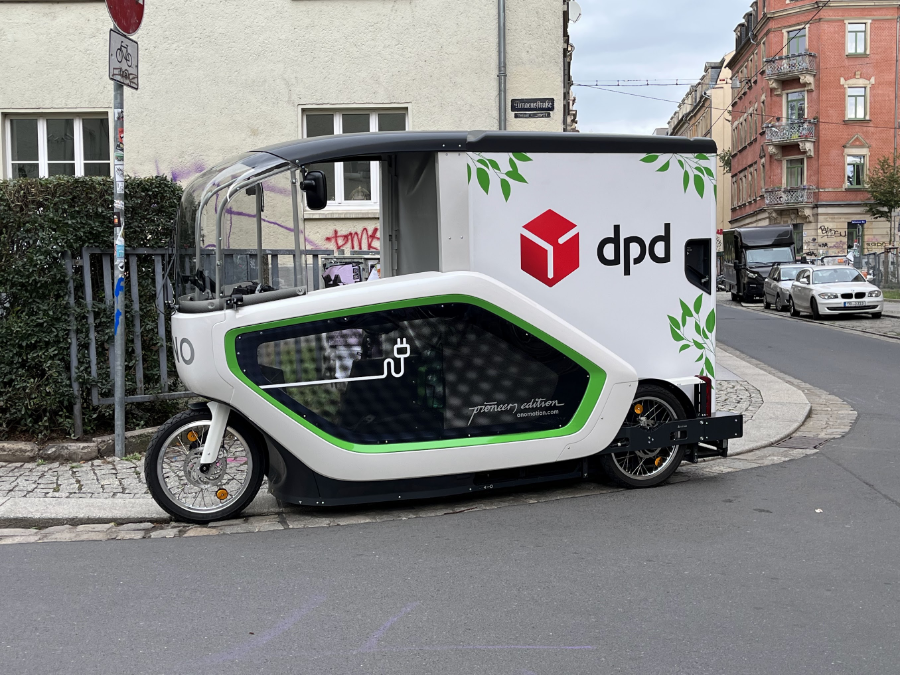
DPD ONO eCargo bike spotted on the street in Koblenz, Germany
Meanwhile, in London…
From January 2026:
The daily Congestion Charge rises from £15 to £18.
The current 100% exemption for EVs ends.
Electric cars move to a 25% discount (with Auto Pay).
Electric vans, HGVs and quadricycles move to a 50% discount (with Auto Pay).
In practice:
ICE vans pay the full £18.
Electric vans and quadricycles pay £9.
Electric cars pay £13.50.
EVs are still better off than combustion vehicles, but the gap is narrower than today. From an operator’s point of view, it sounds less like “no-brainer” and more like “slightly less painful”.
And that’s before you get into how those vehicles are actually charged and used:
Kerbside charging is expensive energy. Public on-street and rapid chargers usually sit well above domestic tariffs on a p/kWh basis once network, maintenance and operator margins are layered in. For fleets that can’t rely on cheap off-peak depot charging, that eats into the running-cost advantage EVs are supposed to deliver.
Depot power isn’t infinite. Many commercial properties sit under tight caps on how much power they can draw without slow, expensive upgrades. If you’re running DC fast charging on site, you often can’t fast-charge multiple vehicles back-to-back without bumping into those limits – so “just turn them around quickly between rounds” isn’t always realistic.
Most operations are multi-modal. A lot of businesses now blend cargo bikes, small EVs and conventional vans. If the only EV you can easily keep in the mix is a cargo bike, and everything else is struggling with cost, charging and grid constraints, rollout can start to feel more like an operational headache than a win – especially if the bike is being asked to compensate for gaps elsewhere in the fleet.
Set that alongside the ZIV discussion and a pattern appears:
Technical rules risk eroding some of the operational edge of carrier cycles.
Pricing and infrastructure constraints are quietly narrowing the practical advantage of other EVs.
ICE vans, by contrast, still slot neatly into existing depots, power contracts and duty cycles.
None of this makes cargo bikes a bad idea. But it does raise the bar they have to clear on reliability, payload and integration if they’re going to feel like a help, rather than “one more special case”, inside already complex urban fleets.
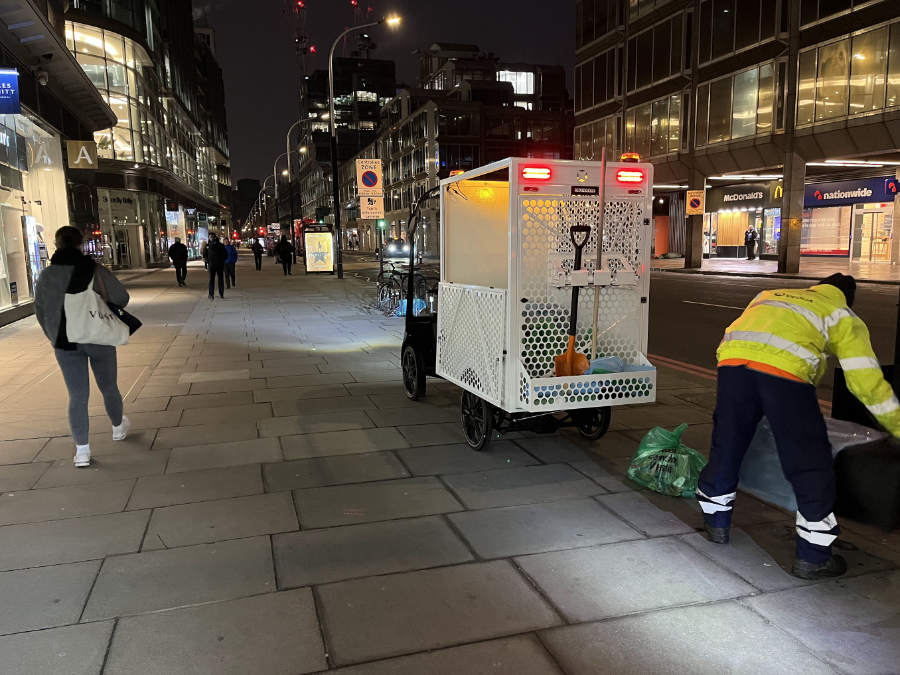
EAV Cage model used during a bin collection round in Central London
Navigating fragility in the rationale
It’s always a warning sign when a product only works because the rules are currently generous.
If your business case for cargo bikes only works:
while EVs are fully, or heavily, discounted in congestion zones, and
while regulators are relaxed about assistance, power and weight
…then the next policy tweak can undo a lot of careful work.
From a design-engineering perspective, I’d much rather help teams build vehicles and systems that:
Hold up under stricter standards like EN 17860, rather than relying on generous interpretation.
Deliver predictable payload and route density even if power/weight caps tighten a little.
Cope a bit better with pricing shocks – congestion charges, fuel costs, new low-emission zones – because the fundamentals of the platform are strong.
That doesn’t make you immune to policy changes, but it does mean you’re not betting the whole platform on one or two favourable clauses.
What this means in practice
Once you strip away the acronyms, this all shows up in fairly practical questions.
1. Design for the stricter view
Instead of designing to today’s kindest interpretation of the rules, it’s worth asking:
If the assistance and weight caps land at the stricter end, can this platform still do its job?
What does this vehicle feel like for the least strong rider on the hilliest round with a full load?
That tends to push you towards:
Being more deliberate about frame architecture, drivetrains and braking, backed up with testing (not just intuition) so the product feels composed even when it’s right up against likely limits.
Building test routes and rigs that explore worst-case use – steep ramps, winter conditions, max payload – early, rather than discovering those problems in the first live season.
If the fundamentals are right at the hardware level, you’re less exposed when the rulebook shifts.
2. Assume incentives taper – and bake compliance in early
On the modelling side, it helps to treat incentives as temporary:
Assume congestion and emissions discounts shrink over time.
Assume grants and pilots don’t automatically get renewed.
Assume access rules tighten for anything that looks more vehicle-than-bicycle in sensitive areas.
If the economics still stack up under those assumptions, you’re on much firmer ground.
And then there’s the compliance blur: EN 15194, EN 17860, national road rules, and the kind of proposals ZIV are pushing. For small teams especially, turning that fog into a clear set of design inputs is half the battle.
Doing that early means you can:
Plot a compliance map: which standards apply, which sales territories they apply in, where likely thresholds might bite, and what that implies for architecture and components.
Turn it into a single, human-readable requirement set, instead of everyone reverse-engineering standards on their own.
Keep an eye on draft standards and proposals while they’re still in consultation, so you get an early sense of where the goalposts might move and can sanity-check your roadmap against that, even if the details change later.
The goal isn’t to outsmart every future policy tweak; it’s to avoid being caught completely off-guard by the ones we can already see forming.
Where this leaves the cargo-bike conversation
None of this is an argument for giving up on better rules. Quite the contrary.
The CCAN declaration is a constructive attempt to anchor the discussion in real-world use: keep carrier cycles within EPAC, lean on EN 17860 and EN 15194, and avoid additional caps that don’t seem tightly linked to actual crash or injury risk.
At the same time, TfL’s congestion-charge changes are a reminder that policy will keep moving – sometimes in helpful ways, sometimes less so.
The stance that feels most useful – and the one I try to bring into projects – is pretty simple:
Engage with standards and legislation early.
Push for frameworks that make it easier to choose low-impact options.
Stay close to draft standards and consultations, so you at least have a rough sketch of where things might be heading and can adjust course before changes are locked in.
That doesn’t magically de-risk everything. But it does make it more likely that, as the rules and charging schemes keep shifting, cargo bikes remain a credible, dependable option rather than an experiment that only worked under last year’s conditions.